
Audio Sources: Acknowledgments and Gratitude
All the sounds — every quack, plink, and strum — come from the real thing. The audio has been edited, arranged, mapped and sequenced*, but it originates in the work of the people and projects below.
Instruments
Jabberblocky's melodies and generative music are played using recordings of individual notes from these instruments.
- Concert Grand Piano — the default piano in Jabberblocky — comes from the Salamander Grand Piano V3, recorded from a Yamaha C5 grand by Alexander Holm, licensed under CC BY 3.0.
- Felt Piano, the softer voice in the generative packs, comes from the VSCO 2 Community Edition Upright by Sam Gossner / Versilian Studios, released under CC0 1.0.
- The Nylon Guitar uses classical-guitar recordings from the Philharmonia Orchestra's sample library. The Concert Harp comes from the Versilian Community Sample Library (VCSL), also by Sam Gossner, under CC0 1.0.
- The Electric Guitar comes from FreePats, a project creating a free and open collection of digital instruments for music production. The recording is their FSBS Bridge Clean Electric Guitar, released under CC0 1.0.
- The cowbell, woodblock, castanets, spring coil, and squeaker used in the Frabjous sound pack also come from the Philharmonia Orchestra.
- The toy-piano samples are via Freesound contributors, "Toy Piano Samplepack" by poissonmort and "Michelsonne piano toy" by beskhu, both licensed under CC BY 4.0.
- The found-sound cork pops used in Frabjous were produced by Freesound contributors dr19 and lupums.
Animal sounds
The barks in Dogs come from an assortment of sources. With thanks to Joseph SARDIN's BigSoundBank, and Freesound contributors 16G_Panska_Dolezal_Stepan, be_a_hero_not_a_patriot, brunoboselli, Daphne_in_Wonderland, designerschoice, felix.blume, Glitchedtones, ivolipa, JoMungus, JonasTisell, JPBILLINGSLEYJR, ken788, NachtmahrTV, nielstii, qubodup, rodrigocswm, Soojay, strongbot, TeTeNoise, UnderlinedDesigns, Vrymaa, and Weak_Hero.
Ducks is, likewise, a flock (apologies) of freely-shared recordings. With thanks to Freesound contributors calodas, owennewo, and squashy555; to DenisChardonnet at BigSoundBank; and to Pixabay.
Most of the meows in Cats were assembled and curated for a deep-learning pipeline built specifically (and successfully) for feline age prediction, and generously shared under CC BY 4.0: van Toor, A., Qazi, N. & Paladini, S. A deep learning pipeline for age prediction from vocalisations of the domestic feline. Sci Rep 15, 34565 (2025). doi.org/10.1038/s41598-025-17986-z
Other contributors
-

Minnie is a good dog
-
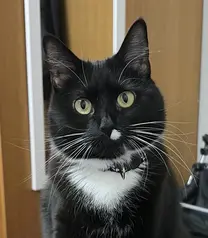
Dahlia has strong opinions, strongly held
-

Nora tries very hard
Music & scores
Jabberblocky's Musical Mode uses public-domain compositions. The playable score data behind each one was transcribed, arranged, or curated by someone, either working solo or as part of a larger effort, such as PDMX, a Large-Scale Public Domain MusicXML Dataset for Symbolic Music Processing. With gratitude:
- J. S. Bach's Cello Suite No. 1 — MIDI sequenced by David J. Grossman (jsbach.net)
- J. S. Bach's Toccata & Fugue in D Minor — transcription by hmscomp (MuseScore)
- Beethoven's Symphony No. 5, Finale — arranged for piano by the great Liszt, sourced from the PDMX open dataset
- Edvard Grieg's In the Hall of the Mountain King — via PDMX
- Mykola Leontovych's Carol of the Bells — arrangement by Xingyu Shui (aka pianofortemaster, MuseScore)
- Franz Liszt's La Campanella (MuseScore)
- Rimsky-Korsakov's Flight of the Bumblebee — transcription by james_brigham (MuseScore)
- Fernando Sor's Study in B Minor, Op. 35 No. 22 — sequenced by François Faucher (Classical Guitar MIDI Archives)
- Scarborough Fair (traditional) — via PDMX
- Gilbert & Sullivan's Major-General's Song — transcription by mls111888 (MuseScore)
- Bella Ciao (traditional) — transcription by PhivosK (MuseScore)
- Bunessan (traditional) — via PDMX
- Kurt Weill's Mack the Knife — via PDMX
- Zequinha de Abreu's Tico-Tico no Fubá
*Depending on the source, recordings are selected, segmented, trimmed, faded, filtered, level-adjusted, normalized, layered, resampled, channel-converted, re-encoded, or mapped across pitches. Scores may be transcribed or extracted, reduced to playable notes and chords, transposed, phrase-mapped, and re-sequenced for interactive playback.
For feedback, suggestions, or corrections, please contact us.